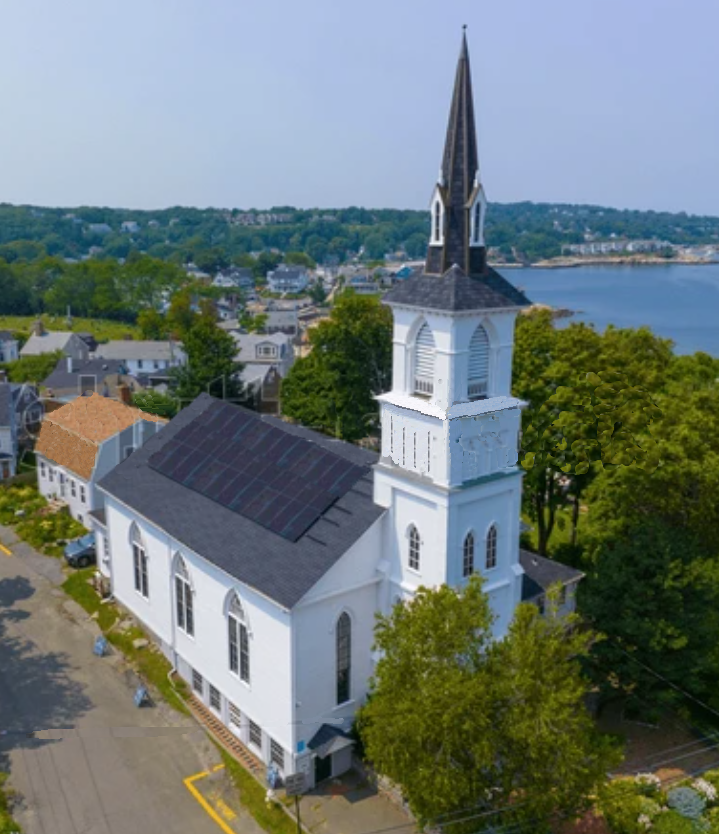

Unitarian Universalist Society of Rockport

UUSR Church Interior
"Since 1821, an open and welcoming religious community acting in conscience and compassion."
4 Cleaves Street, Rockport, Massachusetts 01966 (978) 546-2989

SERMONS

Reverend Susan Moran

The Arrogance of Certainty
At the church fund raising auction, Chuck Francis won the right to tell me what to preach about.  So, Chuck deserves credit for the great title, and the inspiration behind this morning's message.  Any issues with the message, of course, should be taken up with me, as Chuck had no input into the actual writing.  So, here we go-The Arrogance of Certainty.

The world is flat.
African Americans should be counted as 3/5 of a person.
Women do not need to vote.

Through the ages, it is clear that some of what was believed by most, if not all, people, turned out to be completely wrong.  The world is not flat, African Americans are no less human than anyone else, and women may not need to vote, but we have the right to do so.

It is also clear that there are some absolute laws; there are certainties that we can count on.  Every living being eventually dies, we will, in all probability, pay taxes, and, on a cloudy day, if you don't have an umbrella with you, it will rain.  One would think that with so few absolutes, people would be comfortable with uncertainty and be flexible about their ideas.  You would be wrong.  Most people adore their opinions.  And the more people are attached to their opinions, the narrower their perspective becomes.  This tendency to think that what we believe is truth, is found in enough people, one could argue it's the human condition.

I have a colleague whose bumper sticker reads "God bless all Nations" a worthy antidote to the ubiquitous "God bless America" plastered everywhere.  I love America.  I think it's a wonderful country.  It may even be one of the top ten.  But it's not the only wonderful country in the world.  It's not the only country worthy of God's blessing, and what that means requires another sermon entirely.

The certainty with which Americans believe that our country is special, and thus deserves special treatment, has gotten us into all kinds of trouble in the international community.  We act like we are the best, we are always right, we have all the answers.  Moreover, our government operates under the assumption that if you have more, we will have less.  Can't we both have more?  When a friend gets a promotion, don't we want to celebrate with her?  Do we feel that because of her promotion, we won't get one?

I am not naïve about foreign policy.  I believe we need a strong military.  I believe there are real dangers in the world and that we need to protect ourselves.  But many governments want to protect their citizens-not just us, and some seem to do a better job of delivering basic necessities.  But we're too arrogant to ask for advice.

I was raised to believe that I could figure out any problem I had-if I just put my mind to it.  My parents taught us that we were capable and competent and that we didn't need anyone's help.  I would be able to solve all my problems alone.  I never asked anyone for anything.  In my early 40's, life started delivering bad news at my door on a freakishly regular basis.  I was in a bike accident, my husband went jogging and had a fatal heart attack, I had both hips replaced, I got cancer, I broke my shoulder.  The list goes on.  The benefit of all of this was that I needed help.  And it was delivered.  Over and over again.  I now ask for advice on almost every topic.  I ask for help with almost everything-one, because I can, and two, because I need a lot of help.  So, I have gotten much better over the years about realizing that I don't have to do everything by myself.  It's alright to say, "I don't know how to do this".

I am, however, still very much attached to my judgments.  When it comes to opinions, I love mine.  And I've got thousands of them.  I inherited a lot of opinions from my mother.  Mundane ones like hating the circus and never wearing white after Labor Day.  And some of them are about important topics.  I believe that no government should put individuals to death.  I believe that children should be seen and heard; that they be held accountable for their actions, but as children, not as mini-adults.  I believe it is a woman's right to choose whether or not she will have a child.

I have had these opinions for a while-we are old friends.  But I understand that some very smart and thoughtful people disagree with me.  There are very smart and thoughtful people who believe, for instance, that abortion is murder, and that it should not be allowed, under any circumstances.  The current controversy over when a person becomes a person, is not just idle conversation.  People feel passionately about this topic.  With this much passion, trouble is sure to follow.

The debates around abortion and beginnings of life could go on forever.  Or, both sides could acknowledge that their position is one of belief, not fact.  Let me be honest here-I am pro-abortion rights.  I don't want to return to the days of back alley abortions that killed and maimed so many women.  But, I also know that, in the realm of morality, abortion is not as simple as having a tooth pulled.

Having had two miscarriages, and being over 35, I was thrilled to find myself 12 weeks pregnant.  I was ecstatic to see the photos of my babies at 14-16 weeks old, when I had my amniocentesis.  Already at that early age, my first baby had my husband's profile.  She looked like a human being, even if I didn't know she was a girl.  After seeing those photographs, I remember telling my husband that I would not be able to have an abortion.

I was somewhat surprised by my reaction at the time because I had been so staunchly supportive of women's rights to choose, and had been a big supporter of Planned Parenthood.  Let me say that I am still supportive of both, but far more open to the argument that says we have no right to kill another human being.  I also have some experience with the horror of abortion.  It is not anything a woman should take lightly; it should not be considered a birth control method.  But this is just my opinion.

When we forget that our opinions aren't facts, when we are certain we are right, we can get stuck.  It can make us rigid, and closed-minded.  And sad.  As someone put it to me years ago, would you rather be happy or right?  Having chosen "right" for much of my young life, I am pleased to tell you I try now to choose happy.  I remind myself often that everything that comes out of my mouth is just my opinion, and that everyone has the right to disagree with it.

This is an important stance to take in both our personal relationships as well as in our public discourse.  With certainty comes stagnation and stasis.  As Tukaram reminds us, Certainty confines, and it undermines our power.  With uncertainty, change is possible.  It just takes a moment.

I stand in awe of moments that allow for transformation, even if it's just the beginning of years of work.  Every great transformation starts with one little moment when we can clearly see something we could not see before.  In one moment, we can understand that this homeless person is just like me, wanting to be cared about and listened to.  So instead of walking away, I stay and listen and try to help.  In one moment, we can realize that our drinking has gotten out of control and that we need help.  And once you know something, you can't not know it.  There are moments in history that I wonder about.  Moments that allowed history to unfold in another direction from the way it was heading.  I wonder, for example about what precipitated the peace process in Ireland.  Was it a member of the IRA who had just seen one too many of his friends die?  Was it a wife saying to her husband, I am going to leave you if you don't change?  In Ireland, the official peace process was begun in the early 1990's when the leaders of age-old enemy factions were willing to sit down and talk with one another.  The process has not been an easy one, nor one without setbacks.  But here in 2012, Ireland is at peace, and power is shared among parties that were killing each other less than a generation ago.

The seeming impossibility of peace is now a reality.  Perhaps if the pro-choice and the pro-life people could come together and start talking, progress would be made on this delicate subject as well.  Isn't it worth trying?  Could we, at the very least, start by saying that the Pro-life argument isn't completely misguided?  Could we admit that abortion is a really sad and difficult procedure to endure?  And could the pro-life faction admit that this country neglects its children in ways that are cruel and stupid?  There are so many children in need of a good home, why don't we concentrate on the children already here, rather than on the unborn ones?

The arrogance of certainty prevents real dialogue, and thus keeps us isolated and marginalized.  How difficult would it be for Planned Parenthood to invite some of the more vocal opponents of abortion to come and have a conversation?  Perhaps they already have, I don't know.  But something happens when you are sitting at a conference table with another human being, drinking water, and discussing the traffic and the kids and the weather.  It's hard to hate a stranger when you're sitting that close to them.  It could start with a few little words.  Tell me your story.  How has it been for you?  Are there any areas where we can find common ground?

The arrogance of certainty wreaks havoc in our personal relationships too.  My husband died in 2003 and I don't remember specific arguments anymore.  What I do remember is the rage I felt when in the midst of the fight.  Why couldn't he see that I was right?  Why was he being so stubborn?  Why couldn't he understand???

The fact that he was probably wondering the same thing never occurred to me in the moment.  I was too angry and too focused on being right to entertain such a staggering idea.  I wanted Bob to say, "You're right, honey.  I am wrong." And sometimes he did.  But sometimes he didn't.  Sometimes he didn't care that I was sure I was right.  He was just as sure of his own point of view.  Neither one of us wanted to give up control.

In her lovely memoir, Let's Take the Long Way Home, Gail Caldwell writes these wise words: "The old Navajo weavers used to insert an unmatched thread into each of their rugs, a contrasting color that runs to the outside edge.  You can spot an authentic rug by this intentional flaw, which is called a spirit line, meant to release the energy trapped inside the rug and pave the way for the next creation.

Every story in life worth holding on to has to have a spirit line.  You can call this hope or tomorrow or the 'and then' of narrative itself, but without it-without that bright, dissonant fact of the unknown, -consciousness and everything with it would tumble inward and implode.  The universe insists that what is fixed is also finite."

If the universe insists that what is fixed is finite, why can't individuals make friends with this fact?  Why is it so hard to admit that we aren't in control of everything, that we don't know-or that we might be wrong?  Buddhist Nun Pema Chodron writes that "we can never avoid uncertainty.  This not-knowing is part of the adventure.  It's also what makes us afraid...  With practice, we learn to stay with a broken heart, with a nameless fear, with the desire for revenge.  Sticking with uncertainty is how we learn to relax in the midst of chaos, how we learn to be cool when the ground beneath us suddenly disappears.  We can bring ourselves back to the spiritual path countless times every day simply by exercising our willingness to rest in the uncertainty of the present moment-over and over again."  (Comfortable with Uncertainty, Pema Chodron, p. 5, 8).  If only the leaders of the world were familiar with this practice, what a different world we would live in.  The world would be different if the members of our families, and our churches and our assorted associations committed themselves to this kind of practice.

In 2012, let's try to befriend uncertainty.  You can start where you are.  Accept yourself absolutely.  Love your opinions.  Revel in them.  Write them down and say them out loud.  Share them with a friend.  But know them as opinions not facts.  Not absolute truth.  Who knows where this kind of thinking will lead!  I think it's a journey well worth taking.  Let's take it together and talk about it.  Let's admit when we aren't sure; let's admit when we are wrong.  No blame, no shame, just an "I'm sorry, I made a mistake."  It's easy, once you've done it a few (hundred) times.  Just ask my kids, they'll tell you how often I say those words.  I wish you blessings on your journey.
Amen.

Rev. Susan A. Moran
UUSR
January 8, 2012

Back to list